

In our contemporary world, Japan has definitely emerged as a strong bucket-list destination for travellers worldwide. After all, a country with such rich cultural heritage, stunning landscapes, and vibrant city environments provides a little bit of something for each individual interest. However, beneath this influx of tourists also lies a troubling phenomenon known as overtourism, casting a shadow over some of Japan’s iconic cities.
Although overtourism was commonly talked about even before the coronavirus, it has become a pressuring issue again in the Japanese tourism industry due to the volume of foreign tourists recovering to pre-COVID levels in late 2023. Overtourism is characterised by aspects such as overcrowding, environmental degradation, and cultural erosion. It is most often concentrated quite unevenly in a specific locale. Currently, this is particularly evident in Kyoto, the ancient capital best known for its historic temples and shrines as well as traditional arts and crafts. In the heart of the city lies the entertainment district of Gion, a picturesque enclave that has become synonymous with the geisha and maiko who perform their profession of music, dance, and storytelling. As waves of tourists flood its narrow streets, the district has unfortunately become somewhat of a battleground between preservation and commercialisation.
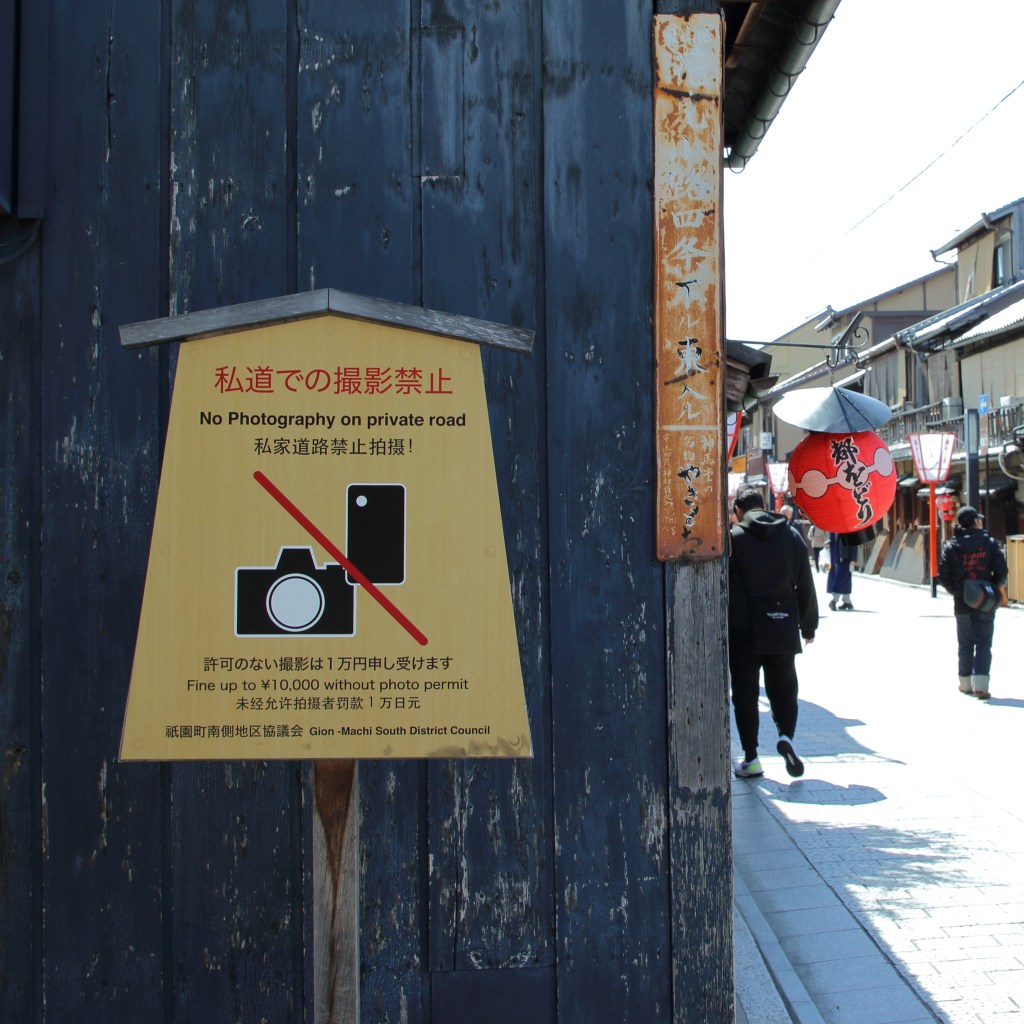
Photography has already been banned in the private streets of Gion since October 2019. However, this has not put a stop to reports of disrespectful conduct, including but not limited to littering and the consistent harassment of geisha and maiko. The situation reached a tipping point when authorities took the necessary step of banning tourists from entering certain parts of the Gion district due to their problematic behaviour. This move by the local residents and officials to protect their community has been met with mixed responses. Ultimately, the radical development only underscores the broader challenges posed by overtourism in Japan, bringing to the fore essential questions about how we should think about cultural integrity and environmental sustainability.
Besides Kyoto, a lot of other major Japanese attractions are also currently considering measures to combat overtourism. For example, Osaka is planning to implement an “entry fee” for foreign tourists in time for the World Expo that is to be held in April 2025. Similarly, the Yamanashi prefectural government already decided to begin regulating the amount of Mount Fuji climbers on the popular Yoshida Trail, even charging a ¥2000 toll fee for those passing through. In addition, as a last resort to badly behaving tourists, the town of Fujikawaguchiko will erect a huge screen in front of their famous Lawson convenience store to block a renowned photo spot of Mount Fuji. Other global developments also mirror the approaches taken by Japanese officials. For instance, in Amsterdam, the capital of the Netherlands, the construction of new hotels was just recently banned as an anti-overtourism measure to enhance the liveability of the city for both residents and tourists alike. I believe that in the upcoming months and years, we will see similar responses by several other local communities against overtourism, indicating the significant changes that will inevitably have to take place in the tourism industry in the near future.
Despite the rather gloomy title and descriptions in this blog post, I am of relatively optimistic nature and see the recent challenges as a potential pathway for developing more sustainable and responsible approaches to tourism. Tourism initiatives aimed at promoting less known and off-the-beaten-path destinations and projects encouraging cultural exchange and mutual understanding offer possibilities for more harmonious and reciprocal interactions in the sphere of tourism. In this process, engaging with local communities in a meaningful way will be key. This ideology is also something that forms the core of my research. While constantly keeping a critical mind and re-evaluating the existing principles of sustainable tourism, we can hopefully reach innovative, locally rooted development and management strategies that bring us closer to more humane and less profit-oriented forms of tourism. Let us think of the risks and negative impacts of overtourism as a lesson that needs to be overcome in order for a paradigm shift to happen in the tourism industry.
 Eetu-Antti Hartikainen
Leave a comment